Augmenting The Associate Role In The Age of AI
Associate Led Design Thinking Initiative
Challenge: How do you evolve the associate role for the GenAI era without losing the human expertise that makes it valuable?
Business Need— The company needed to scale AI adoption in research to align with its positioning as a provider of cutting-edge AI implementation research.
Associate Need— Associates felt underutilized, time-strapped, and craved more professional growth opportunities. At the same time, entry‑level and junior roles like this one are among the most vulnerable to AI displacement
Enablement and Operations Need — The enablement team needed research production to become more efficient to support the companies strategic goals.

Design Approach
Applied the human-centered design framework, beginning with divergent thinking to uncover everything we could about the challenge. Assembled a diverse team of 5 associates across teams to tackle the challenge together.
Deliverables designed from scratch as an associate-led initiative:
Project proposal
Interview guide
Qualtrics survey
Research Process
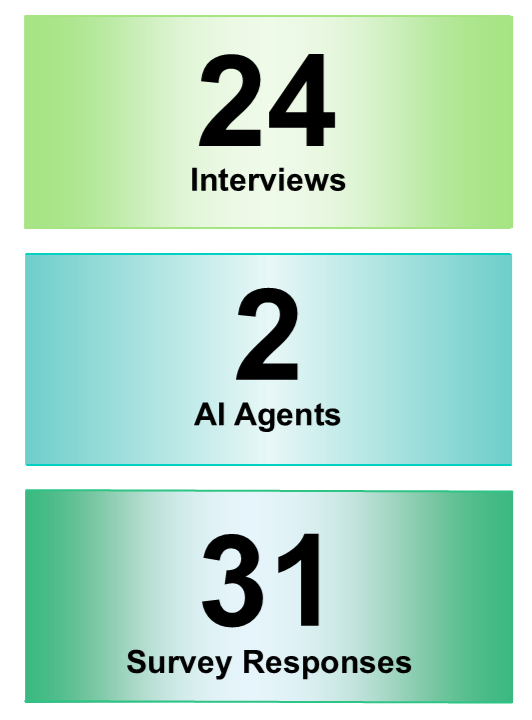
Conducted 24 in-depth interviews across roles and seniority levels. We led hour-long interviews with current and former associates across teams to understand sentiment toward the role, AI adoption, and professional development opportunities, grounding our insights in firsthand qualitative research.
Built AI agents to scale and validate qualitative analysis. We built two AI agents to identify key themes and quantify how many interviews aligned with each theme. Because we conducted the interviews ourselves, we were able to validate the agents’ outputs using firsthand context, with human oversight ensuring themes and insights accurately reflected participant perspectives.
Designed a quantitative survey to establish baseline metrics. We surveyed 31 associates to assess current AI adoption and time spent on use cases. Questions were intentionally designed to avoid leading language and to capture concrete, baseline measures that could be used to track progress over time.
Associates are an underutilized resource. Associates want more stimulating, creative work and fewer project‑management tasks; leveraging the inherently collaborative nature of the role would unlock more of their potential.
Time is the biggest barrier to growth. Associates consistently cited lack of time, not lack of interest or ability, as the primary constraint on pursuing stretch work.
AI adoption is held back by distrust, not disinterest. Associates recognized AI’s potential but felt behind, skeptical of using it for complex tasks, and were worried they were training AI agents to replace them.
Writing and data skills offer the highest ROI. Associates prioritize these skills above others and and those would most improve research quality and productivity.
Associate goals and business goals are more aligned than leadership realized. Associates’ goals directly support business needs for higher‑quality research and faster, more effective AI adoption. Investing time and resource to upskill associates would advance core business priorities.
Key Insights
Recommendations

Workshop 1: AI Agent Prototyping To drive adoption, we must earn associate’s trust in AI agents through collaborative development.
Workshop 2: Upskilling the Associate Role To support associates professional growth, we need to intentionally expand content creations skills through co-creation.
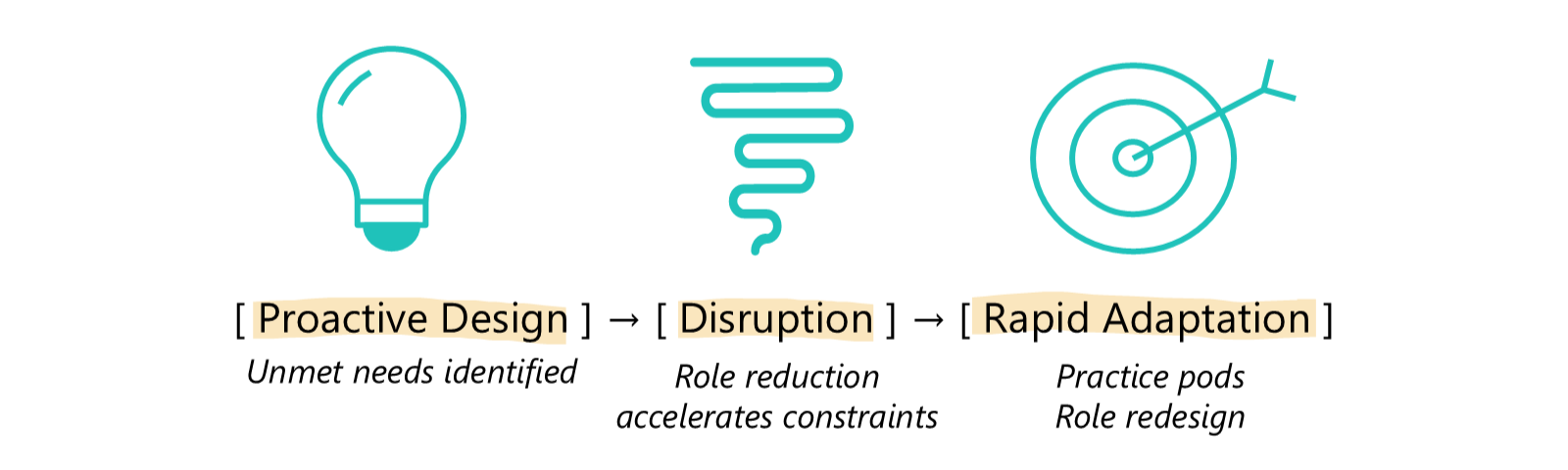
Proactive insight into unmet associate needs enabled rapid adaptation during disruption.
Design work must adapt to organizational disruption. Shortly after our presentation, the associate role underwent significant and sudden layoffs, forcing an immediate shift from long‑term design to real‑time response.
Existing barriers rapidly intensified. The constraints we identified—limited time, administrative overload, and untapped AI potential—were exacerbated by layoffs and became impossible to ignore.
Associates needed immediate support and relief. We received approval to launch mini, associate‑specific AI agent practice pods, enabling collaborative experimentation to offset new bandwidth pressures.
Longer‑term capability building remains on the roadmap. The full two‑part workshop series is still planned for the summer.
Grassroots research shaped formal role redesign. Our team was asked to serve as a council of reviewers as leadership rewrites associate roles and responsibilities, placing our work at the center of a live organizational redesign.